Recent Reads

We’ve had our first rhubarb harvest, every other dinner’s salad is fresh from the garden, and last night’s bike ride included nine bunny sightings. It’s not that warm yet, but summer has definitely started! One of the best parts of summer is… Well, who can pick just one? I like it all! But right now I’m excited about summer reading. I just finished a great Bible Study program that ran through the school year, so my regular book reading diminished drastically since September. This summer my work load is decreased a bit, and while I hope to maintain consistent study of scripture, I’m excited about extra time for real books, too. So I can’t say I’ve been reading two books a month like I did last year, but I’m going to blog about the past year’s worth of literary edification now in case you want to pick anything up for your own summer reading list. My natural bent is towards devotional, historical, nerdy, or “self-help”-ish books, but I have been richly rewarded by some intentional fiction reading, so I’m hoping to be more balanced with reading stories and “real life” in the future.
(These are listed here alphabetically by author.)

Jayber Crow by Wendell Berry
I’ve had Wendell Berry on the radar for years. In college I frequently babysat for the children of a Berry scholar (as in, wrote a real book about it), and sometimes I thumbed through the books on their shelf. But I didn’t get anything read start-to-finish until now, and I am kicking myself for taking half a decade to get around to it. This author is gently profound, and his prose beautifully marries an understanding of God’s dual revelation (in scripture and nature) with an uncanny knack for describing the human condition. Berry “gets” God, and he “gets” man. I will say that I found it especially intriguing that a confessing Baptist would write a story where the main character spends much of his life in confusion about faith and veers sharply off the path of orthodox Christian belief at the end, but I would still highly recommend this book as a story about loss, grief, growth and redemption.

“This grief had something in it of generosity, some nearness to joy. In a strange way, it added to me what I had lost. I saw that, for me, this country would always be populated with presences and absences, presences of absences, the living and the dead. The world as it is would always be a reminder of the world that was, and of the world that is to come. … I am a pilgrim, but my pilgrimage has been wandering and unmarked. Often what has looked like a straight line to me has been a circle or a doubling back. …The names of many snares and dangers have been made known to me, but I have seen them only in looking back. Often I have not known where I was going until I was already there. I have had my share of desires and goals, but life has come to me or I have gone to it mainly by way of mistakes and surprises. Often I have received better than I have deserved. Often my fairest hopes have rested on bad mistakes. I am an ignorant pilgrim, crossing a dark valley. And yet for a long time, looking back, I have been unable to shake off the feeling that I have been led — make of that what you will.” -Jayber Crow, by Wendell Berry.

***
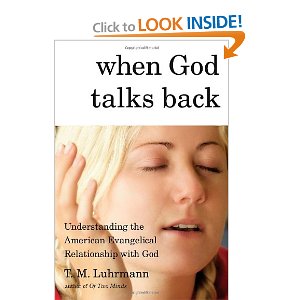
When God Talks Back by  T.M. Luhrmann.
This is a huge volume based on an anthropologist’s report of spending years in two different Vineyard churches throughout the country. I feel like I’m cheating because I actually returned this to the library before I finished it, but I would like to finish it sometime, and I still recommend this to anyone who is intrigued by anthropology or curious about the psychological study of prayer. Which would be… probably no one. I’m okay with being a little nerdy here: I thought it was really interesting. And I truly appreciated that a non-believing author managed to write a book about evangelical prayer without an overwhelming air of cynicism. Though I don’t necessarily agree with some of her conclusions, I appreciated that she took people seriously and wanted to figure out how the human side of prayer works. My biggest beef with what I’ve read so far is that Luhrmann keeps using the word “evangelical,” while most evangelicals probably wouldn’t call the churches she visited mainstream. But, whatever. The evangelical Christian movement is almost impossible to narrowly define, even in a book that’s 300+ pages like this one.
***
Gilead by Marilynne Robinson
Gilead is a beautiful story, told in letters from an elderly minister near death to his seven-year-old miracle son. (While every child is a miracle, one who is seven when his father dies of old age is more likely to be referenced as such, I suppose.) The San Francisco Chronicle said Gilead “explores big ideas while telling a good story,” and I would recommend this for anyone who has thought about God’s will, singleness, marriage, childlessness, parenting, grief, disappointment, ministry, or the meaning of life. Which means, everyone. I liked this so much that I listened to the audio CD a few weeks after reading the book, and I was so excited to share this novel with some friends that I recommended it to several people right away. Then I found out most of them had read it already. So I feel like I was late to the party, but you should read it now, because this is one of those things that isn’t worth missing!

“I don’t know exactly what covetise is, but in my experience it is not so much desiring someone else’s virtue or happiness as rejecting it, taking offense at the beauty of it.” -Gilead, by Marilynne Robinson.

***
Still: Notes on a Mid-Faith Crisis by Lauren F. Winner

I have loved several of Lauren Winner’s other books, especially her conversion memoir “Girl Meets God,” so I was very curious about “Still: Notes on a Mid-Faith Crisis.” Written out of the spiritual torment she faced grieving her mother’s death and doubting her faith in a difficult marriage resulting in an (admittedly) unjustifiable divorce, Winner tells her raw story of doubt and faith. Many times, it seemed that her “journal-entryish” writing (like CS Lewis’ “A Grief Observed,” but a bit more organized) left me feeling emotionally brutalized along with her – doubt is a painful thing, and it hurt to read about, too. In both knowing personally that Christian marriage is not all picnics and rainbows, and walking alongside a dear friend in the aftermath of marital dissolution, I have a hard time feeling sympathy for the trauma Winner faced after leaving her husband. I don’t know the whole story behind that, but I do know she reflected on those grave choices with honesty and renewed faith. It’s not as though she can go back and change it, and I am grateful God meets us where we are instead of where we should be. In many ways, this book reminds us that life is tough and God, though sometimes hard to understand, is good. Winner writes with a haunting narrative voice and her words are thought-provoking in some ways I didn’t expect. For that reason I think it deserves mention here.

“The enthusiasms of my conversion have worn off. For whole stretches since the dream, since the baptism, my belief has faltered, my sense of God’s closeness has grown strained, my efforts at living in accord with what I take to be the call of the gospel have come undone. …And yet in those same moments of strained belief, of not knowing where or if God is, it has also seemed that the Christian story keeps explaining who and where I am, better than any other story I know. … I doubt; I am uncertain; I am restless, prone to wander. And yet glimmers of holy keep interrupting my gaze.” (‘Lord, to whom shall we go? You have the words of eternal life.’ John 6:68, esv.) – Still, by Lauren F. WInner.

I have a few things on my summer reading list already (Eric Metatexas’ Bonhoeffer biography is in progress, Return of the King by Tolkien, the Huger Games trilogy by Suzanne Collins, In This House of Brede by Rumer Godden, and Great Expectations by Dickens), but I’d love to hear more suggestions if you have any to offer!

A Cruel Month

April is the cruelest month, breeding
lilacs out of the dead land, mixing
memory and desire, stirring
dull roots with spring rain…
– TS Eliot, The Wasteland (“Part 1- The Burial of the Dead”)

I’ve never really understood much of the TS Eliot poem “The Wasteland,” to the point where I’m usually not sure the author even had a logical meaning that anyone was supposed to comprehend. This is totally sour grapes on my part, of course. He just means something I have not yet grasped. So I get lost in every attempt, but I keep coming back to these words because some of the imagery and the opening line, “April is the cruelest month,” resonates so clearly with me.

I have had many good Aprils, particularly 1986, when I was born, and the month is not always bad to me. But rain falls on the just and the unjust alike, so I have seen some cruel Aprils. The worst of them were five and six years ago, when Aaron and I were dating. During the first April there was much weeping, wailing and gnashing of teeth, since I was dreading his departure for a deployment to Iraq. (In addition to the cruel April business, Eliot’s poem also says “I will show you fear in a handful of dust,” and confronting the dust-to-dust nature of this all was, indeed, terrifying.) When his pre-deployment training began I didn’t know we would have a brief summer reunion and thought we had kissed goodbye for the year. The day after he left I threw myself into a heap on my bed, surrounded by some girlfriends, and declared “I am being ripped in two!”

"kissing the war good-bye" was above my dorm dresser. also pictured: valentine's flowers.

the "birthday jar" I sent Aaron for his 22nd birthday. I was sick so my mom snapped this while I was in bed.

The second cruel April was a year later, and I was tiredly, anxiously, wearily, fearfully awaiting his imminent return home. It was an awful year in so many ways, and some days it seemed like every breath was a reminder of how fragile we all are. There were funerals, injuries, battles, sickness, nightmares, care packages, letters, emails, and lots of crying (on my part). The experience was more harrowing for Aaron than for me, of course, which appalls me a little to this day.  It has been said that “the darkest hour is just before dawn,” and those words were remarkably true for me that year. Sometime in February, I broke down with a friend while we were leaving the music building. I had been counting down to a rough estimate of Aaron’s homecoming date, and I remember sobbing “There are 73 more days! I can’t do it! This is impossible!” Then it felt like everything was downhill from there, and the last few weeks of deployment were full of insomnia and grotesque nightmares whenever I could get some sleep. I knew after all the difficulty of that year we were not home free yet. Nearly every day I heard people saying “You must be getting so excited!” and I just wanted to scream that he was still in danger and something could still happen to him and there is nothing exciting about someone you love being in a war zone, ever, even if they are scheduled to come home soon.

Then (At last! Finally!), five years ago today, the cruelty of that April came to an end and he was returning home. At that point, I almost wished my insomnia would have stayed a little longer since I was studying, writing, and practicing like crazy at the end of the semester, trying to work ahead as much as possible. Several professors graciously adjusted my scheduled finals so I could celebrate this homecoming – one even handed me an exam, winked, and told me to bring it back before graduation. Grace upon grace.

waiting!

Aside from the homecoming, which I have written about earlier, my favorite memory of this time came a few days later. Aaron was safely home, and the family sat on the couch praying for his upcoming TV interview. His mom asked that God would give him words to speak to the reporter, and his brother interjected, “English words!”

at last!

at last!

It’s interesting to unpack important lessons after trials like this. A few weeks into that summer, I sat with a family friend and watched Aaron perform important ushering duties at his sister’s wedding. (It was on a beach, and I remember him saying, “oh… sand…”) Someone remarked to me that Aaron’s presence here was proof of God’s faithfulness to us, and springing out of the growth and learning of the past year I had to correct them. Yes, God is faithful and gracious, and we received our loved one back from war… but a terrible outcome for that year would not have changed God’s character. I am so thankful that divine faithful character was expressed in this way, but I can’t pretend God “owed” us this safe homecoming. Things could have taken a tragic turn and that April would have been crueler than all the rest, and we could been weeping through a “the Lord gives and the Lord takes away” sort of lesson in it all. But for whatever reason, that was not the case, and we now reflect on this with humility and gratefulness:

 “Who has ever given to God, that God should repay him?” – Romans 11, niv.

“The LORD has dealt bountifully with you. ” – Psalm 116, esv.

Some of these Aprils have been cruel, but I am grateful for what has sprung out from that.
Welcome home, five years ago today.

a well-examined birthday

There is a certain realization that comes upon a person examining life on their 26th birthday: I am no longer in my early twenties; I am closer to 30 than 20. While I know, deep-down, that this is good, exciting, and normal, it is a little unsettling. So I have done some thinking about the next four years before I hit that big milestone and come up with a list of 30 things I want to do or accomplish before my 30th birthday. Planning like this can be a dangerous thing. Life is very much out of my own control and for as much as I plan, I can’t guarantee that  circumstances will fall in line with my plans. But it also seems wasteful to live without intention and dreams. So, in whatever ways I can make things happen, which may be not at all, I have thirty goals – some big, some small – for the next four years of my life. It is my intention to complete this stuff before April 12, 2016, but, to quote our favorite online hunting show, Midwest Whitetail, “We’ll see what happens.”

1) Figure out gardening. (Spoiler alert: this is in progress already because it might take all 4 years to turn my black thumb green.)
2) Learn Greek. I own the books and I’ve played around with this on my own, but I get distracted while writing out the alphabet. The shapes are pretty and they make me think about other things. I might need to take a real class if I want to make serious progress. I swear, some days it  is no small miracle that I can get anything done at all.
3) Grilling. I should figure out this miraculous thing that occurs when I hand raw meat to my spouse and he magically turns it into a delicious main dish with appealing crosshatch lines.
4) See the Grand Canyon.
5) Get back into the Guitar. I have played guitar for about 10 years, and I always get to the point where I really get the hang of playing bar chords without having to look at what I’m doing… and then forget about it for months. Also, I should probably learn to read tablature notation. This is very important, because it occurred to me that God may call me to a Bluegrass ministry, and if so, I should be prepared to follow.
6) Make and can salsa from our fresh garden tomatoes. [Done! Summer 2012]
7) Finish the Lord of the Rings books. [Summer 2012. Slogging through some parts of Return of the King is the killer, but totally worth it.]
8) Go Camping. Tents. Campfire. French press coffee. ROASTING S’MORES.
9) Real Vacation. This means no cooking and sleeping in real beds. [Mexico, 2013.]
10) Leave the Country. I have been to 23 countries, but not in the past 6 years. [Mexico, 2013.]
11) Go out with Aaron while he is hunting.
12) Go fishing and catch something I can eat.
13) Read my camera manual so I can take better pictures. 
14) Keep my car. I can’t control if it gets run over or something,  but I want to keep it as long as possible!
15) Become a parent (and save extra money in case this means pursuing an adoption.)
16) Keep my closet photo-ready for a month.
17) Get my PhT (“Put him Through”) so you all can send your Christmas cards and wedding invitations to Dr. and Mrs. Hummel. [December 6, 2013!]
18) Get nice family pictures of us. 
19) Visit a winery and go on a tour.
20) Finish my wedding scrapbook and then stop pretending like I care about this hobby enough to make time for it and get rid of all my stuff. (We have been married almost four years.)
21) Try downhill skiing.
22) Learn 4 new challenging piano songs. At least one a year.
23) Make donuts.
24) Buy a new couch that I love. I need to love how it looks. Probably from a real store, unlike our current furniture. [Update: Possibly off the agenda until 2017 or later.]
25) Have a house with a real guest room. You know… one that has a bed for company instead of a Craigslist couch that is, I promise, actually pretty comfortable.
26) Get the hang of cookies. I have had a few successes and a lot of failures in cookie-baking already, but I’d love to find consistent success. I have a feeling it may be connected to my current disdain for strict recipe-following.
27) Go shooting with Aaron.
28) Do another photo-booth with Aaron because the one from when we are dating is, to be honest, totally adorable.
29) Teach myself to like olives[If they are excellent quality, I’m happy with them plain and no longer pick them off Greek Salads, so I’m calling this a win.]
30) Hold off on getting a smart phone as long as possible. [Bit the dust November, 2013.]

love is the lesson

Most glorious Lord of life, that on this day,
Didst make thy triumph over death and sin:
And having harrowed hell, didst bring away
Captivity thence captive us to win:
This joyous day, dear Lord, with joy begin,
And grant that we for whom thou didst die
Being with thy dear blood clean washed from sin,
May live for ever in felicity.
And that thy love we weighing worthily,
May likewise love thee for the same again:
And for thy sake that all like dear didst buy,
With love may one another entertain.
So let us love, like as we ought,
Love is the lesson which the Lord us taught.

-edmund spenser.

holy week and the death of dreams

A few weeks ago, I was really starting to feel like I had it made in life. Not that things are perfect or how I would plan them! You know, I had to work for years in a job I didn’t like, but I was delightfully strategizing about increasing my teaching load, coordinating to tutor homeschoolers in the fall, and preparing for more ministry endeavors with my flexible schedule. While I’m not particularly happy about turning another year older without any accompanying littler birthdays to celebrate, I have a deep appreciation for many things I can do now that would be nearly impossible if we had children to care for. And we’re managing on a very tight budget, but we love our little house and someday Aaron will graduate, and even now we have a lot more than most people around the world. I want you to know that my gracious acceptance and good attitude here was not easily won. It took a lot of work to get there! But for a short, short time I was able to rest in the comfortable beauty of surrender and acceptance. And then, it crashed down when I got one of those heart-stopping calls that you never expect to get, the kind that makes you look at the phone afterwards and say “Did that just happen? Really?”

I suppose the story starts, quite innocently, the week before the phone call when Aaron mentioned he had a special one-on-one meeting with his advisor. He wasn’t particularly worried, but noted that this seemed very unusual. There were hours of conversation while we were tiling the kitchen, otherwise he probably wouldn’t have said anything in the first place. I forgot about this until he said something before leaving on Monday morning, and I wasn’t very alert because I’d barely slept from excitement about the kitchen progress and Aaron’s recent “75% commitment” to redoing the bathroom this fall. So I said a quick prayer and forgot about it until I got a text message later. While I would love to pretend we are a syrupy couple who constantly express our mutual undying affection in 160-character snippets, Aaron does not text me during the day. So even seeing that was a little unsettling, and then I read “…wanna move to Ithaca NY?” Um, what? I was confused and asked him to call me, and he did. Aaron also does not call me during the day. And I knew the news was big because he called and then he unfolded the story of his professor moving their lab across the country, telling me we were invited but not required to come, that he would get a raise and potentially an Ivy-league doctoral degree if we left…and I can’t even remember what else he said, but I knew we were thinking very seriously about moving right away. (When I prayed that I wouldn’t have to keep the deer head in my living room, I meant that the deer head should move, not the living room.) The next few weeks of our life became a massive blur of questions about selling our house, sacrificing all the music and job stuff I have worked for, and figuring out what else we should consider to make a decision about the whole thing. And because this move would mean we’d want our house sold by August, we gave ourselves a deadline of less than two weeks to make a final decision.

It would be far too laborious to go over all the aspects of this huge decision-making process here, but I will say that, miraculously, we concluded that it is best to stay where we are for now. We made the choice pretty quickly and it seems like the answer is the “easy” one, but this was not a “snap” decision. I’m grateful that this was a very short trial, but it was a time when it seemed like everything we worked for in the past few years might be given up quickly and the future looked like one big, giant, and possibly scary mess.

Come now, you who say, “Today or tomorrow we will go into such and such a town and spend a year there and trade and make a profit” –yet you do not know what tomorrow will bring. What is your life? For you are a mist that appears for a little time and then vanishes. (James 4, esv)

Yes, in the chastening lesson of this all we must remember we are a mist, we are vapor, we are dust. And if we who have eternal souls can be compared to dust and ashes, how much more transient are the products of our striving – our dreams, our plans, our business, …our tiled floors? I find profound connections here to ponder this week when we Christians especially contemplate the mystery of Jesus’ passion. It is overly dramatic to say this, I admit, but in the midst of that confusion and anxiety I really felt like I had grabbed onto a bit of what massive heartache the first “Holy Week” must have been – the political and religious landscape was in uproar, Jesus had to dread the cross before him, and for the disciples it looked like their hopes and dreams were destroyed. We miss a lot of the compassion and beauty in the Resurrection if we forget that emotional turmoil.

And I know this sounds crazy, but in deciding to stay we also had to give up the new dream of the life we would have after moving. We planned on becoming kayak bums in beautiful upstate New York and spending a few years exploring the East coast. It’s hard to lay that dream aside, even when I know there is no way to have both things I want. In articulating the confession, this reminds me of the time I was watching a friend’s baby who had a pacifier in her mouth and found another one on the floor. At a certain point, she was hanging on to the second pacifier and realized she would have to take out the first one if she wanted to suck on the second from her hand. She found the dilemma so distressing that she cried too hard to have either one in her mouth at all. And I don’t want to spend my whole life like that, but I’m sure that’s what I must look like to God right now.

(I think our awesome patio is my favorite part about living in this house, so I am consoling myself by focusing on how much I like it out here. And if the background is blurry, I can forget  how much work there is left to do in the yard.)

listening in the wilderness

I feel strange about taking Lent seriously this year because, on the surface, I’m mostly participating on my own. This isn’t something my church (or even my husband) is observing, and so I find myself feeling a little misplaced. I know many people in evangelical circles might argue against Lenten practices like extra church services, fasting and “giving things up.”  And regardless of one’s stance on observing liturgical seasons, every Christian would agree that faith is an internal work of God, not external, not of ourselves. I believe there is much value in traditional celebrations like this, because corporate expressions of faith that spring out from the genuine belief of individuals are a strong witness of our Christian unity and devotion. And though the people I spend my day-to-day life with aren’t really walking on this road with me, I’ve found encouragement that I am actually not alone. Since this Lent thing is something many Christians all over the world are doing right now, too, by setting aside a few weeks as a significant season of prayer and repentance in my own life, I’ve found common ground with friends and family who worship in a variety of traditions and styles very different from my own.

One of my dear Lent-observing friends, Bethany, is a treasure all her own. We met when I was leading her freshman bible study in college and really hit it off over some cookie-baking in my apartment. I always felt those bible study girls taught me more than I ever hoped to teach them, and my friendship with Bethany consistently reminds me of this unexpected blessing. I continue appreciating her beautiful articulations of faith and life, especially recently while reading the same copy of the Bible I used when we studied together, rediscovering profound “Bethany Kj” commentary scribbled in the margins.

While she blogs occasionally about teaching, literature, food, church, and having a cool apartment, Bethany agreed to share some “serious” reflections about Lent here. Her thoughts on this topic began at a young age with the traditional soup dinners and extra services at her Missouri-Synod Lutheran church, and today she finds Lent observance as an encouragement in the midst of weariness and brokenness. In reading this, I found myself thinking of the seventh chapter in Romans where Paul talks about wrestling with the “body of death,” which is what we do during Lent, and praises God that the solution is in Jesus and the resurrection.

“Thoughts on Lent,” from Bethany Kjergaard.
My earliest memories of Lent are sense memories. I remember the smell of the soup for the communal supper before the service (I didn’t eat soup, too picky). I remember the early darkness. We would arrive to church at twilight, and we would leave just before my bedtime. I remember snatches of the liturgy we sang (“let my prayers rise up like incense before you”). The hymns we sang during these Wednesday night services were much more melancholy than the ones we sang on Sunday morning. The services were much shorter too.

As I grew older, Lent became one of my favorite seasons of the church year. Last year I don’t think I missed a Lenten service (and I really don’t like going to church all that much). I think I treasure Lent because normally I feel that I’m supposed to pull it together for church each week. We are exhorted to be joyful in the Lord. Most Sundays I’m surrounded by happy, smiling people. Not so during Lent. During this season I can take the time to be grief-stricken at my sin and my hard heart. I don’t have to “fake it until I make it.” Rather, I can look around me and see that I am broken and the world is broken. As a Christian, one of the most difficult things is looking at the world around me and realizing that while Christ came and was resurrected and lives, it often does not seem that he has made much of a difference. We still have wars, poverty, and famine. The universal church does a lot of good things and a lot of bad things. Time marches onward.

I’ve been reading different meditations on Lent and what this season ought to mean to us. One of the most powerful comes from St. Benedict, and it is the idea of the New Adam and the Old Adam. Old Adam fell and was cast out of paradise into the wilderness. Humanity wandered in this “wilderness” until the New Adam (Christ) journeyed out into the wilderness to bring him back. Lent is recognition that although our path has been made known to us, we are still in the wilderness, the darkness of this world.

I think the darkness of the church during these services made the biggest impact on me. It was very dim with only the altar candles lit. Bernard Clairvaux commented that sin entered the world through sight (Eve being tempted by the beauty of the fruit), but salvation comes through the hearing of the Word. Darkness certainly obscures sight, but it cannot stifle sound. Lent is a time that allows me to admit that I am fallen, in the wilderness, in the darkness and yet despite that I can listen.

Rendering unto Caesar

Since it is the adventure of self-employment that gives me more free time and makes our taxes just slightly  more complicated than last year, I’m the one hacking through our year-end statements and getting ready to prepare our yearly tax returns with Turbo Tax as Uncle Sam’s April deadline looms in the distance. While setting up for this process, I have already succumbed to emotional eating (too much coffee, leftover pizza, and hazelnut wafer rolls, if you must know) and am now listening to classical music in hopes that it will bring a sense of calm and classy-ness to the day as I accomplish the task at hand.

Naturally, the quote that comes to mind in these times is from the Gospels.

“And Jesus answering said unto them: ‘Render to Caesar the things that are Caesar’s, and to God the things that are God’s.’ And they marvelled at him.”
– Mark 12:17, the king james version.

It is always the KJV diction that sticks in my head for this passage, and I’m getting very distracted by the word “render.” In this context it means “return” or “give back,” but I’m amused that it can also describe the process of separating fat from meat by the application of heat. Though the double meaning may be unintentional, it seems like an apt picture for this process. We will soon know how much “fat” the government will claim for 2011!

(That exclamation point is supposed to be ironic. I am not actually excited about this.)

giving up

A little over a week into Lent, I’m surprised at how scattered my thoughts about self-denial and repentance remain. I suppose it’s not a very fun thing to think about. At least with the other “big” Church season of Advent, we prepare for the revelation of Word made flesh while planning holiday menus and anticipating the spiritual experience of getting loads of loot. Not so with Lent! For nearly two thousand years, Christians have spent forty days in repentance and self-denial preparing to observe the most extreme series of events in human history: Jesus’ undeserved betrayal and gruesome death that make way for the eternal victory of His resurrection.

It can be rightly said that this is a special season of grief for sin and brokenness in ourselves and the world, and turning away from these things back to God. Of course we should seek repentance at all times, but that doesn’t make Lent irrelevant. There is much to gain in approaching this corporately and systematically — or, to use the evangelical lingo, “in community” and “intentionally.”  Compared to our full observance of Christmas (and sometimes Advent), we evangelicals tend to tend to sweep Lent and Easter under the rug. Perhaps this is further evidence of our own brokenness, indicating that we don’t always take the the death and resurrection of Christ as seriously as his birth.

My thoughts and convictions on this topic are still not fully formed, but mostly my point here is that these forty days are a special time of examining my own heart and orienting myself more fully towards the gospel. In giving up small things – this year, it’s sleeping in past six o’clock and using the computer after dinner – I’m more aware of how much I hang on to and how much Christ gave up for me. And I’ve failed at one or both of these things every day. This teaches me even more about my own rebellion and powerlessness, and how much I must cling to God in all things. I want Lent to be a big deal because these tangible experiences help break me out of my own fallen perspective and emotions. Rightly understanding my own state of helplessness and defeat is the only way I can rightly understand what the gospel means. In Lent, when I turn my heart towards sorrow for sin and grief for all that brokenness has wrought in my life and the world, I gain a deeper understanding of St. Paul writing: “For as in Adam all die, even so in Christ shall all be made alive!” and the traditional liturgy stating: “Thus we proclaim the mystery of faith – Christ has died, Christ has risen, Christ is coming again!”

Though “giving up something for Lent” alone is meaningless, with a contrite heart the tradition of fasting and denial teaches us about surrender, sacrifice, and salvation. These lessons are profoundly valuable. I’m glad to be observing Lent this year, because I know in “giving up”  little things  to make room for greater devotion to God, I’m learning more about giving up entirely.

“…whoever loses his life for my sake will find it.” – Matthew 10:39, esv.

Decluttering: What to do with bad books?

During recent months of working towards the elusive goal of having less stuff, I’ve given away more than half our books. As educated and literate people with mild pack-rat tendencies, we have accumulated more books than necessary and I was excited to pare down our collection. I was surprised how easy this was, maybe because we have access to multiple libraries, online bookstores and our Kindle.

For the most part, the book-sorting process was very straightforward. Since I can donate to the library for a tax deduction I decided against gambling with used book sales online, and most of the books easily sorted between “keep” and “donate.”

Any book I questioned was put in an “undecided” sack. But then I came back and started thumbing through them and realized they promoted some disturbing themes. I’m not trying to go all Farenheit 411 bookburning here, I have no reason to keep them and I’m not comfortable donating if someone else might take these ideas seriously. So the lonely books sit on my closet floor and I haven’t decided what to do about it.

Out of this wacky collection, the most ludicrous volume is Music and Morals: Dispelling the Myth that Music is Amoral, by Kimberly Smith. I used this as part of a broad research base for my senior thesis in college and I distinctly remember sharing some great laughs with my advisor at the ridiculous material we found here.

The basic premise of this book is that hymns and western classical music written before 1820 inherently honor God while other styles do not. This hits close to home for me because I love the music she favors, but the author makes outrageous and illogical arguments to support her false belief. Arguing that Christians should only sing and listen to her “God-honoring” music, she claims newer music causes people to move sensually (a term she uses interchangeably with “immorally”), says jazz is the musical equivalent of a one-night-stand, and blames contemporary music for teenagers developing romantic intentions towards their peers at youth group. Most disturbingly, this book subtly promotes racist values by excluding the rich musical traditions of Asia, Africa, South America and any other cultures from her rigid definition of “moral” music. (I’m pretty sure if God made people all over the world, He’s glorified in music that comes from all over the world, too.)

I suppose my fear is not so much that one would take this book seriously, but that they might think Christians like me take this book seriously. It makes my whole religion look bad. I have a handful of books I won’t read again but don’t want to promote – so what do you think is the best solution here? Trash, burn, donate,  “accidentally” leave in garage so they are susceptible to water damage?

I might end up keeping this one around after all, just for laughs. After reading this next blurb, I must wonder what she would say about how often I sing Old McDonald with kids in music class:

Popular Music/Animal Music (1900+) Directed to the Undisciplined and Unrestrained Passions of Man

“…Some of the music and dances of this time had animal names, and America learned such dances as the Jitterbug, the Fox-trot, the Monkey, and the Funky Chicken. This parallels the theory that evolutionists believe humans to be nothing more than educated animals.”

Thou art the journey

I love this prayer from Boethius, a 6th century Christian:

O Father, give the spirit power to climb
To the fountain of all light, and be purified.
Break through the mists of earth, the weight of the clod,
Shine forth in splendor, Thou that art fair weather,
And quiet resting place for faithful souls.
To see Thee is the end and the beginning,
Thou carriest us, and Thou dost go before,
Thou art the journey, and the journey’s end.

-Boethius, c. 480-524 AD.

(photo found here)