a look at our life as a WAHC.

As the typical use of the English language degenerates rapidly, probably in inverse relation to the availability of social networking, those of us who read things online often see acronyms that succinctly describe a person’s current state, such as SAHM for Stay-at-home-mom or WASP to describe White, Anglo-Saxon, Protestants. Honestly, I don’t understand why these four-letter titles are such a common part of web lingo, since other than texting or twitter most technological communication doesn’t have a word or character limit. (I might also argue that over-using these things reveals a limit to one’s moral character, my own included, but that’s not the issue here.)

Those objections aside, if this is how people are talking these days I suppose I can’t completely beat it. So I’m coming to terms with the facts: this week we have been a DINK (Double-income-no-kids) WAHC (Work-at-home-couple). The first title seems less glamorous when I clarify that these incomes would keep us well below the poverty level if we only had one of them.

As a change from his usual 70-hour researching work week in the lab, Aaron is laboriously writing for a deadline at the end of this month. As if this doesn’t sound hard enough on it’s own, scientific research publications look like another language. Working from the couch at home is a small comfort in the midst of this task.

And when I’m not changing the world one music lesson at a time, my grand central office is in the kitchen. I hear stand-up desks are all the rage these days. The location is a bit torturous because I keep getting distracted and trying to clean things.
As apparent in our pictures, we have been drinking copious amounts of fresh french-press coffee.

This DINK WAHC status allows opportunity to observe the shiny nose of our deer in it’s temporary home above the fireplace,

and check out the guppies in our new fish tank to see if they will be popping out babies under our careful watch.

…but the biggest benefit of this is coming up with ridiculous inside jokes. This morning, it’s that I shout, “I am (You are) being summoned!” in a British accent when one of us get a text message.

We were just talking about how we’re spending years in a stage of life neither of us really imagined being in for long. Of course graduate studies are demanding, but this PhD program is strenuous and it feels like it’s taking forever, and we’re uncertain about how many “roots” to put down where we live, childless, pinching pennies by necessity… It is very, very easy to feel like we’re just in a holding pattern, waiting for the rest of life to get here. So on the surface life usually feels quite stagnant, but we’d be missing out on so much if that is all we focus on. It often seems strange to settle into this DINK WAHC life, but it’s what we’ve got. Of course we look forward to things being different, and it can be difficult to balance contentment now and hoping for what is ahead. Weeks like this are such a gracious reminder that what we’ve got now is good, too.

Who hopes for what he sees? But if we hope for what we do not see, we wait for it with patience… Likewise the Spirit helps us in our weakness. For we do not know what to pray for as we ought, but the Spirit himself intercedes for us with groanings too deep for words. And he who searches hearts knows what is the mind of the Spirit, because the Spirit intercedes for the saints according to the will of God. And we know that for those who love God all things work together for good, for those who are called according to his purpose.
– Romans 8, esv.

love’s noon in nature’s night

It hardly looks like Christmas should be coming soon! The weather outside is warm enough to fetch the mail without a coat and there is no snow in sight.  I usually forget about some of the beloved nativity hymns and readings until the last minute, but with a whole nine days to spare, here are some portions of my all-time favorite holiday poem. I love the imagery of Christ as the light, the eternal day, and all wonders in one sight.

From “In the Nativity of Our Lord God: As sung by Shepherds” by Richard Crashaw.

Come we shepherds, whose blest sight
Hath met love’s noon in nature’s night;
Come lift up our loftier song
And wake the sun that lies too long.


Gloomy night embraced the place
Where the noble Infant lay.
The Babe looked up and showed His face;
In spite of darkness, it was day.
It was Thy day, Sweet! and did rise
Not from the East, but from Thine eyes.

We saw Thee in Thy balmy nest,
Young Dawn of our eternal day!
We saw Thine eyes break from Their East
And chase the trembling shades away.
We saw Thee; and we blessed the sight,
We saw Thee by Thine own sweet light.

Poor world (said I), what wilt thou do
To entertain this starry Stranger?
Is this the best thou canst bestow?
A cold, and not too cleanly, manger?
Contend, ye powers of heaven and earth
To fit a bed for this huge birth.


Proud world, said I; cease your contest
And let the mighty Babe alone.
The phoenix builds the phoenix’ nest,
Love’s architecture is his own.
The Babe whose birth embraves this morn,
Made His own bed ere He was born.

Welcome, all Wonders in one sight!
Eternity shut in a span.
Summer to winter, day in night,
Heaven in earth, and God in man.
Great little One! Whose all-embracing birth
Lifts earth to heaven, stoops heaven to earth.

To Thee meek Majesty! Soft King,
Of simple graces and sweet loves.
Each of us a lamb will bring,
Each a pair of silver doves;
‘Til burn’t at last in fire of thy fair eyes
Ourselves become our own best sacrifice.

Adoration of the Shepherds by Caravaggio

“fear not”

Whether you focus on the spiritual themes of Advent or jump ahead into Christmas celebrations, the weeks leading up to the holidays are full of waiting and excitement. While anticipating Christmas brings joyful hope, patience for other things in life is often very raw, destabilizing and scary. Especially when life is wearisome, the holiday waiting can hit a nerve of underlying or unrecognized fear.  It’s easy to picture happy children marking passed days on the calendar expecting another magical December 25th, but the rest of life isn’t like that. We don’t know what, when, or even if things will happen, and the things that do end up happening might be hard or painful. Depending on the person and their circumstances these contingencies may be especially terrifying, but it’s safe to say we all face this battle in some way. At this time of the year it might feel like the chasm between happy hope and our own gaping wounds is uncrossable. Uncertainty can make celebrations feel so painful for some, and these challenges seem worse with messages all around urging happiness and merriment.

There’s no use hiding these hard feelings, and I’ve been thinking about this because this theme of nagging anxiety has been a theme in so many conversations I’ve had lately. There are varied stories, of course, but most of us respond to all sorts of pain by asking similar questions:
What if I don’t succeed in this new endeavor – grad school, starting a business or job, parenting, paying off debt, leadership responsibilities, moving?

     What if the person I love rejects me and I’ve poured myself out for nothing?
     What if it takes forever to recover after this awful thing?
     What if things don’t get better?
The letters I-F in “what if?” give us a quick way to reveal what I Fear, and I confess a sinking familiarity with this list because I’m asking the same questions on some level every single day. I don’t think these fears are unique to anyone!

It shouldn’t be that surprising to confront growing fear while preparing for Christ’s coming. The Israelites must have mused, Our prophets seemed like they were crazy anyway, we were captured and in exile, and now we’ve had hundreds of years without a messenger from God… What if this is all a joke? Shouldn’t the Messiah be here by now? An angel had to command Joseph not to fear taking Mary as his wife. The shepherds were terrified for one of the most glorious fresh-air Angelic choir concerts of all time. And even today we’re bombarded with skepticism about Jesus’ return: Look at people like Howard Camping! Is it crazy to think this is real? Shouldn’t Jesus be back by now?  Human fear permeates the story of Christmas, so why shouldn’t contemplating the mysteries of Christ’s coming bring our own everyday fears to light as well?

The Christmas story is beautiful here as it validates and releases these fears with  the messages of our Advent contemplations – hope, peace, joy and love.
Weary Israel: This is the branch from Jesse, with the spirit of the fear of the Lord, which remedies all the rest of your fears.
Take courage, Joseph: These crazy and embarrassing circumstances you don’t understand fulfill my promise to bring forth salvation.
Good news, lowly Shepherds:  Salvation comes for all people, including you.
Be not afraid: God is incarnate, dwelling among us that we may behold him.

Reinforcing the truth of scripture, many Christmas carols proclaim the Christ child is the antidote to fear.
Yet in thy dark street shineth the everlasting light!
The hopes and fears of all the years are met in Thee tonight.
– “O Little Town of Bethlehem” words by Philip Brooks, 1867.

Saints before the altar bending, watching long in hope and fear,  
Suddenly the Lord descending in His temple shall appear!
– “Angels from the Realms of Glory” words by James Montgomery, 1816.

Come, thou long-expected Jesus, born to set thy people free
From our sins and fears release us, let us find our rest in thee!
– “Come Thou Long Expected Jesus” words by Charles Wesley.

(Advent Starry Night by Virginia Wieringa)

And it’s interesting to note what happened after these Christmas story fears were confronted. Joseph woke up from his dream and obeyed the angel’s command.  The shepherds went from their fields to find the stable in obedience to their instructions. They responded to fear by acting on what God had revealed to them, and that’s the same path we can take to push past fear. In yielding any worry, big or small, we encounter the ultimate revelation God has given us – Christ, the Word made flesh.

Be not afraid; say unto the cities of Judah, Behold your God!”   – Isaiah 40, king james version.

[image here]

kicking off Advent

We’re celebrating the first Sunday of Advent this evening! I haven’t been able to work up the energy to think about doing the usual Christmas decorating, but I’ve had fun planning some new traditions for Advent. This season is all about joyful patience and anticipation, celebrating both those who waited for Jesus’ birth and our wait for his return in glory.

The first tradition we’re instituting (after intending and forgetting since 2008) is lighting Advent candles every Sunday night. I found these cute little glasses at Goodwill and I love them, but I’ll have to remember to look for better purple and pink votive candles next spring so I can stock up for next year.

four advent candles with the pure Christ candle in the center

The other thing we’re trying is a Jesse Tree! This is a twist on a Christmas tree, where there is a new ornament to hang every evening that corresponds with a devotional reading. Or maybe Christmas trees are a twist on the Jesse tree. Either way, we’re doing one of these this year in place of a usual evergreen. It would be awesome to have the same ornament tradition with a Christmas tree, but I am feeling very lazy about putting that together for now. I’m excited about this because a Jesse tree is a tangible way to celebrate the lineage of God’s faithfulness throughout history leading up to Christ’s birth and learn from those who faithfully waited for the promised Messiah. I think it will take a few years to collect a full season’s worth of ornaments, so some of mine will be pieces of paper or drawings for now! From the looks of this picture I will need to some better branch hunting tomorrow, too. Oh well! This is what it looks like for now, and I already started making an ornament for the reading on Monday.

these branches of the jesse tree are ready for ornaments!

That’s what we’re starting out with this year, and here are a few great resources for Advent if you want to think about any of this stuff yourself:
1) This is a fun song from singer/songwriter Andrew Peterson about the genealogy before Christ. It’s a great musical expression of the things we’ll spend some extra time meditating on this month.


2) Ann Voskamp has a Jesse Tree Advent Devotional available if you subscribe to her blog A Holy Experience. (It would be worth your time to subscribe anyway.)
3) I love this article on Advent from Bobby Giles and these Advent prayers from the Gospel Coalition.

It is marvelous that Christ came and is coming again – we are blessed to contemplate these mysterious gifts!

There shall come forth a shoot from the stump of Jesse, and a branch from his roots shall bear fruit. And the Spirit of the Lord shall rest upon him, the Spirit of wisdom and understanding, the Spirit of counsel and might, the Spirit of knowledge and the fear of the Lord. -Isaiah 11:1-2, esv.


a glorious harvest

Even though we’re staying home for a modest Thanksgiving celebration, our cozy house has been bustling for days with culinary preparations and we look forward to enjoying all the wonderful things we love doing for the holidays: logs blazing in the fireplace, hot wassail, music, excessive cheese consumption and a little extra luxury reading. Aaron says these are slightly pretentious activities, but the truth is that we’re just really awesome.

With our other traditions, I’ve noticed that we always get into philosophical money discussions around the holidays, too. These conversations ask not so much “How much are we spending on travel and gifts?” but “Do we like the direction our lifestyle is taking us? What do we want to correct in our current financial path?” Even this year, after we absorbed a significant income reduction and made some noticeable cuts in our spending so I could quit my day job and teach music at home, our conclusion is the same as in the past: we are happiest when we live simply. A shared attitude of renewed contentment is one of the things I love most about this time of year…. but what does it say about our general cultural prosperity that a graduate student and self-employed musician can make a conscious decision to be more frugal? Our cup of blessing overflows! We praise God for the rich supply he has brought us and pray that our lives will become wholesome grain for His glorious harvest, too.

Come, ye thankful people, come, raise the song of harvest home;
all is safely gathered in, ere the winter storms begin.
God our Maker doth provide for our wants to be supplied;
Come to God’s own temple, come, raise the song of harvest home.

All the world is God’s own field, fruit as praise to God we yield;
Wheat and tares together sown are to joy or sorrow grown;
First the blade and then the ear, then the full corn shall appear;
Lord of harvest, grant that we wholesome grain and pure may be.

Even so, Lord, quickly come, bring thy final harvest home;

Gather thou thy people in, free from sorrow, free from sin,
There, forever purified, in thy presence to abide;
Come, with all thine angels, come, raise the glorious harvest home.
– “Come, Ye Thankful People, Come” by Henry Alford, 1844

…Okay, did you think this was going to be a post of thoughtful Thanksgiving commentary? I’m way too ADD to stick with one thing for very long. Those who want to see what our kitchen looks like can now offer thanks for this gift I present: Check out this video of how un-finished (and yet, so beautiful!) the kitchen is looking these days!


veteran’s day

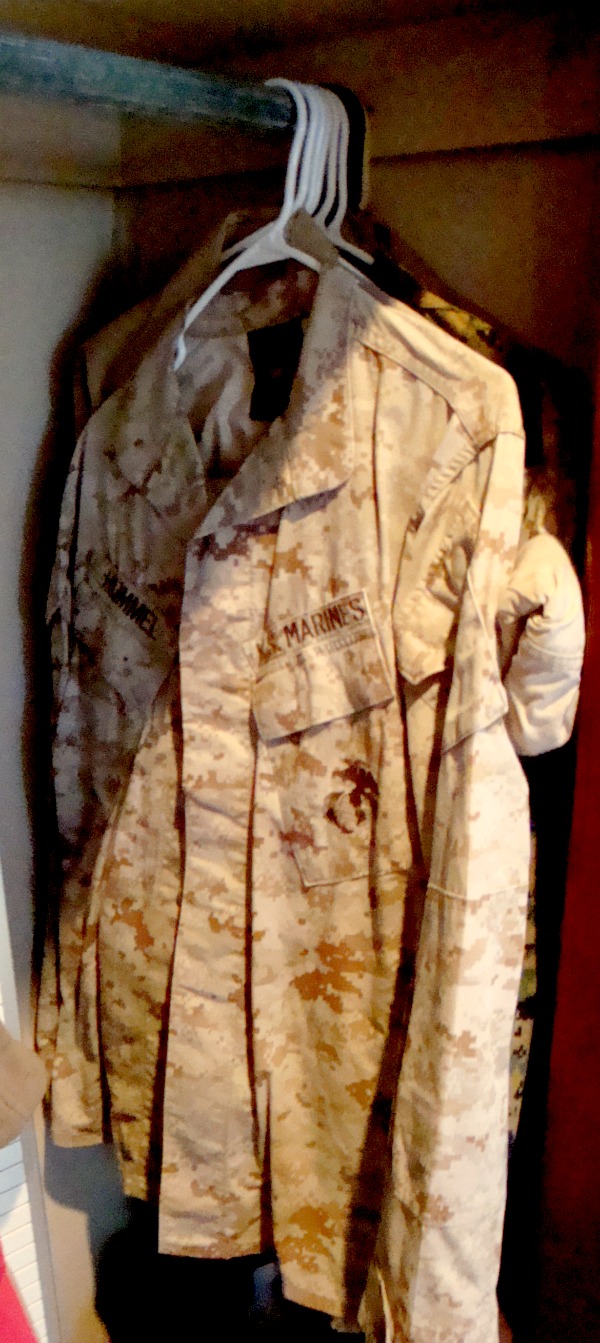
desert cammies in my closet

Today in America we celebrate our Veterans. This is especially poignant for me because I’m married to one. Aaron enlisted in the Marines during college and found out he was going to Iraq shortly after we started dating. He spent a year training for and completing his deployment before safely returning home.  On occasion it occurs to me that things could have been very, very different.  Sometimes I have a little flashback to those days of wondering “Will I ever see him alive again?” when I see a supportive bumper sticker or hear a clueless person rant about war and the middle east, and my heart jumps to my throat whenever I hear a phone with the same ring tone I used while Aaron was in Iraq. I call these things my own “mini post-traumatic-stress” episodes. I mentioned that I had a small kitchen disaster yesterday and my 4-year-old glasses protected my eyelids from strands of hot, exploding squash. As I reflect on the kindness of God’s common protection there, it’s very humbling and a little terrifying to know my own husband’s life was preserved by a much grander series of unknown providential defenses.

I can’t say exactly what reflections Aaron would offer, but on this Veteran’s Day I’ll share some of what I first wrote to friends and family shortly after Aaron’s return from Iraq four-and-a-half years ago.

***
Have you appreciated the legs and arms and lives of the people you love today?

It is no secret that everyone is “dealt a different hand” in the “card game of life.” God plans different things for each of us. I don’t understand why some things happen to me and not to other people. Why do I have the life I do when others face different circumstances? Why did I get this life and not someone else’s?

My boyfriend was deployed for a year. For seven months he was serving in Iraq, fighting at the front lines. Lots of men in his battalion were killed. This country needs many brave men and women to serve in different capacities. Some work on computers or cook on the bases. Others, like Aaron, kick in doors and perform raids. These men are made almost entirely vulnerable to attacks of the enemy during their operations. On the relationship side of things, his sporadic phone calls were quite infrequent, poorly connected, and very short. I prayed fervently for him every day, and am overwhelmingly grateful for his safe return.

While he was deployed, I found myself occasionally considering the mystery of God’s will that this man was for me and in danger so far away when others can spend a lifetime without dealing with anything nearly so harrowing. Now that he is home, I find myself marveling the Divine plan with a totally different perspective. Why is it I get my love home safe and free from injury when others don’t get a safe return, or any return at all?

At his homecoming, when the families lined the walkway where our Marines marched into the gymnasium, we saw men coming in on crutches, in wheelchairs, missing arms. In the crowd, I saw a man cradling an inconsolable woman. Was she just an emotional mother, aware that her healthy son battled the same terrorists these men did? Was one of these wounded men her son — carried inside her body for nine months, raised for two decades and then sent to war? Did this woman have a son who died in Iraq and should have returned with these men? I don’t know who she was and I don’t know her story, but I can’t forget her tears.

After Aaron’s return, when I was still at school, someone gigglingly said: “I bet you are glad to have him home in one piece!” It made me want to cry. By the grace of God, I don’t even remember who said that to me. They certainly hadn’t seen the same scene I did at Aaron’s homecoming. Many people have used the “in one piece” phrase in conversation with me and I never know how to respond. It isn’t that I don’t like having Aaron home safely; I have never been more glad about anything in my life. Referring to someone as being “in one piece” is relevant for this situation precisely because some people don’t come home in one piece. Or come home at all. And I don’t think it is cute or thoughtful to reference that sad fact in the least.

I am fully, completely, absolutely thankful for Aaron’s safe return and I am so proud of him. Unlike those who throw powerful words around tritely, I know what it is to be glad that someone is in one piece.

I am so glad last year is over!
***

Yea, though I walk through the valley of the shadow of death, I will fear no evil for Thou art with me. …Surely goodness and mercy will follow me all the days of my life; and I will dwell in the house of the Lord forever.  – Psalm 23, king james version.

Thou art not so unkind…

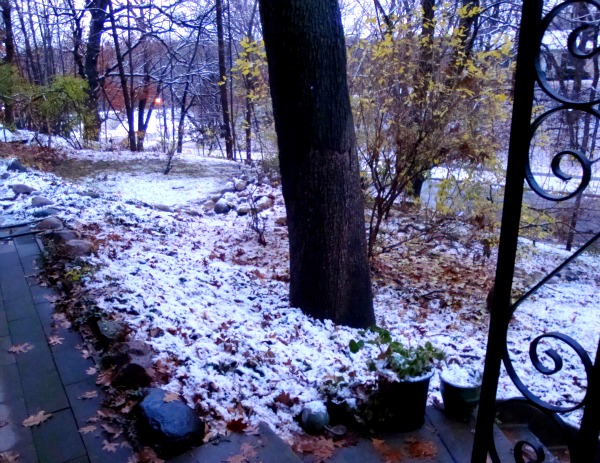
first snow of the season, as seen from the front door

Blow, blow, thou winter wind
Thou art not so unkind
As man’s ingratitude;
Thy tooth is not so keen,
Because thou art not seen,
Although thy breath be rude.

Freeze, freeze thou bitter sky,
That does not bite so nigh
As benefits forgot:
Though thou the waters warp,
Thy sting is not so sharp
As a friend remembered not.

-Blow, Blow Thou Winter Wind
from “As You Like It” by William Shakespeare.

leaves under the snow

It’s not really that cold or windy right now, but with the excitement of a first snow-that-sticks-for-a-while (why does it always make me feel like I’m five years old?) it’s good to remember that no winter wind matches the coldness of an ungrateful spirit.

Praise the Lord, Oh my soul,
and forget not all His benefits…
…who satisifies you with good…
…he does not deal with us
according to our sins
-Psalm 103, esv.

joyful, joyful

For some reason, I always feel like there is great pressure to just “be joyful” without acknowledging that joy is a fruit of the spirit. It’s something that we receive from God,  not something we need to achieve in order to please Him. Of course, we should be joyful. Scripture clearly tells us to “Shout for joyBe joyful in all things…  Count it all joy…” and it’s undeniable that a heart in union with God is a heart of joy.  The conflict here comes when the rubber hits the road: life is hard and joy is not a natural response in the face of difficulty.

Thankfully, this joy is not at all a burdensome command placed on weary shoulders! It is a gift. God delights to give us gifts, and when joy seems out of reach we can (must!) ask for it with confidence.  I love that the hymn Joyful, Joyful We Adore Thee abounds in encouragement. This song points us to God who gives joy instead of demanding something that seems so impossible to achieve on our own.

Joyful, joyful, we adore Thee, God of glory, Lord of love;
Hearts unfold like flowers before Thee, opening to the sun above.
Melt the clouds of sin and sadness; drive the dark of doubt away;
Giver of immortal gladness, fill us with the light of day!

All Thy works with joy surround Thee, earth and heaven reflect Thy rays,
Stars and angels sing around Thee, center of unbroken praise.
Field and forest; vale and mountain; flowery meadow, flashing sea;
Chanting bird and flowing fountain call us to rejoice in Thee.

Thou art giving and forgiving, ever blessing, ever blessed,
Wellspring of the joy of living, ocean depth of happy rest!
Thou our Father, Christ our Brother, all who live in love are Thine;
Teach us how to love each other, lift us to the joy divine.

Mortals, join the mighty chorus, which the morning stars began;
Father love is reigning o’er us, brother love binds man to man.
Ever singing, march we onward, victors in the midst of strife,
Joyful music leads us sunward in the triumph song of life.

-Joyful, Joyful text from Henry Van Dyke in 1907.

acquainted with grief

What a full summer for us! There are plenty of exciting pictures of long-awaited kitchen progress to share soon (I’m cooking on the new stove already and we have the bar counter top ready to install!), and I’m very pleased with some other home projects we have accomplished as well, like making over the brick fireplace and relaying some stone pathways outside before reseeding all the grass. This has been a good season, and we are grateful for the chances to improve our home and see so many beloved friends and family. …And then at the end of this excellent summer, I find myself thrown into situations where grief is all around, both for myself and those I hold dear.  This is truly a heavy thing to think on and discuss.

The Thinker

Someone who isn’t in the midst of this can pull all sorts of cliche comments out of thin air, trying to explain gut-wrenching heartache by saying things like,  “Everything happens for a reason,” or “Things will get better; your good time will come soon,” but those are shallow answers to one who is devastated by sadness. A trite comment cannot explain away the painfully simple truth: grief is hard, dark and lonely. Whether you are witness to the deep soul-groaning of the bereaved or experiencing it yourself, the weight of difficulty seems unbearable and cruel. It is true comfort for a Christian to cling to Jesus, the man of sorrows and acquainted with grief, in these times.

He was despised and rejected by men; a man of sorrows, and acquainted with grief; and as one from whom men hide their faces, he was despised, and we esteemed him not. Surely he has borne our griefs and carried our sorrows; yet we esteemed him stricken, smitten by God, and afflicted. But he was pierced for our transgressions; he was crushed for our iniquities; upon him was the chastisement that brought us peace, and with his wounds we are healed.
All we like sheep have gone astray; we have turned—every one—to his own way; and the Lord has laid on him the iniquity of us all.  (Isaiah 53, esv)

If God is for us, who can be against us? He who did not spare his own Son but gave him up for us all, how will he not also with him graciously give us all things? …Christ Jesus is the one who died—more than that, who was raised—who is at the right hand of God, who indeed is interceding for us. Who shall separate us from the love of Christ? Shall tribulation, or distress, or persecution, or famine, or nakedness, or danger, or sword? …No, in all these things we are more than conquerors through him who loved us. For I am sure that neither death nor life, nor angels nor rulers, nor things present nor things to come, nor powers, nor height nor depth, nor anything else in all creation, will be able to separate us from the love of God in Christ Jesus our Lord. (Romans 8, esv)

only one came back

(this is my first midweek meditation – a little something I’ve been thinking about, shared for your encouragement and edification.)

But now indeed I find, Thy power and thine alone
Can change a leper’s spots and melt this heart of stone.
– Jesus Paid It All, Elvina M. Hall.

A few weeks ago I stood among congregants at church, singing “Jesus Paid It All,” and pondered a verse that talks about changing a leper’s spots. No, not a spotted leopard. A leper; a person who has leprosy. Amid recollections of flannel graph and puppet shows,  most who spent any time in a Sunday School classroom know that this strange disease called leprosy is mentioned often in Bible stories. Some memorable accounts  include Moses’ and Aaron’s sister Miriam, Army commander Naaman from Syria, and the ten men who sought Jesus for healing in the gospels. Now the leprosy mentioned in the Bible was probably a catch-all name for all sorts of infectious skin condition, including (but not limited to) what we now call Hansen’s Disease which destroys the  nerve endings of a person’s skin, particularly the limbs and extremities. So it’s not that this leprosy destroys a victim’s body, it just prevents a person from knowing they’re destroying themself. While a healthy person might step back from hot sand or carefully clean and bind a wound, someone with leprosy can’t feel that they’ve burned the bottom of their feet or that the gash on their hand is infected and septic. A leper doesn’t know they are doing things that are harmful because they are unable to feel their body’s natural warning signal – pain.

Though we probably can’t identify with these stories directly because infectious skin disease is not much of a threat in the comfort of first-world living, there is still a profound lesson for us here. Aren’t our hearts like this? After struggling or disappointment, when we often get to a point where we are at least a little numb? Or amid long battles, where our hearts are so taxed that we don’t feel what we’re supposed to? When we work so hard to avoid a painful situation that we ignore all affliction and don’t recognize our coping methods are actually self-destructive? A leper in ancient days would have been cast out of society to prevent passing the disease to their village. Isn’t that the second step for us with leprous hearts, too? Whether these dysfunctional hearts mean we push others away or they pull back from us, numbness often leads to isolation from the people who should be closest to us in times of difficulty.

So what do we do about this? We see the answer here:

  …He was met by ten lepers, who stood at  a distance and lifted up their voices, saying, “Jesus, Master, have mercy on us.” When he saw them he said to them, “Go and show yourselves to the priests.” And as they went they were cleansed. Then one of them, when he saw that he was healed, turned back, praising God with a loud voice; and he fell on his face at Jesus’ feet, giving him thanks.
-Luke 17:11-16, esv.

These ten lepers had no power by which they might declare themselves healed, and neither do we. I’m not talking here about the kind of emotional pit that calls for drastic lifestyle and medicinal treatments, but of the temptation towards self-pity and putting up “walls” to avoid dealing with things that might hurt. No work of man can cure every ill twist of the heart and facing the reality of a hardened heart can make life seem more frustrating than ever. Yet even if we sense we are at a distance and not close to the Lord, we can shed light on this numbness and cry out  for healing as the ten, “Jesus, Master, have mercy on us!”

If we have to be lepers – and indeed we are – let us  be like the one who first called for mercy and then turned back alone with praise and thanks.