learning forgiveness

Hardship brings with it an unwelcome guest that stays much longer than the original suffering: a new and unfamiliar set of personal-connection tools. Life difficulties are hard not just because of the initial situation, but also because moving through dark suffering changes relationships and the way you interact with people, whether you like it or not. I was just marveling at how grief is not a one-time experience but an ongoing spiritual journey while managing an internal battle with myself, processing a bunch of recent conversations that were really hard and hurtful for me. They were challenging not because there was anything wrong with the others involved, but because I have suffered and then because of this I am different. Healthy, encouraging, refreshing relational connections for me happen under a very different set of rules than they might for someone else.

[Image credit HERE]

[Image credit HERE]

I live in the real world, and I am blessed with people all around me, so I connect with many others for work, fun, church, ministry, and community projects. Sometimes this blessing is a challenge to my heart – all this connecting means that, by default, I have to do a lot of forgiving. And it’s forgiving for things I can’t ask an apology over, wiping clean my heart’s slate of these very real offenses that will never be recognized as such by anyone else. I’m in the middle of a huge chunk of this right now. It feels like I have been doing this for a long time, and it is easy to grow quite weary.

But natural weariness isn’t the defining factor here; I’m a Christian, which means the gospel is always relevant to my life and there is supernatural strength accomplishing what I cannot. I read the Psalms and know God’s mercy is over all that He has made. So I have to remind myself these moments of salty-wound-rubbing and salty-tear-spilling are all covered by that mercy, preaching to my own heart that this is part of why the Lord has compassion on us, why he suffered and saved. His clemency is entirely superior over any of these perceived wrongs, and I need it extended to me even more than to any of this stuff going on around me. His mercy is over me, and them, and those flippant words, and the abundance of flippant words I’ve carelessly spilled, and my sadness, and all this every-day experience of the Fall.

The Lord is gracious and merciful, slow to anger and abounding in steadfast love.
The Lord is good to all, and his mercy is over all that he has made.
The Lord is faithful in all his words and kind in all his works. 
The Lord upholds all who are falling, and raises up all who are bowed down. 
The Lord is righteous in all his ways and kind in all his work.
My mouth will speak the praise of the Lord, and let all flesh bless his holy name forever.
-Psalm 145, esv. 

A voice in Ramah

“A voice was heard in Ramah, weeping and loud lamentation, Rachel weeping for her children; she refused to be comforted, because they are no more.” – Matthew 2:18

Well! Fall has been outrageously busy for us and lots of good things are going on. I’m stretched far in all directions, but fall is one of my favorite seasons, and I’m really thankful that we haven’t spent these cooler months under the heavy weight of grief like we have during autumn in the last few years. One of my big projects has been working on some stuff about ministry and awareness for pregnancy and infant loss. I have some thoughts here to share as a follow-up to a conversation I had on a radio program on Friday about Christians ministering to each other after suffering miscarriage and infant loss. (If you’re interested, you can listen or watch that HERE.) Although Aaron and I are not particularly secretive about the babies we lost in miscarriages during the past few years, I haven’t really written about this topic publicly before. Privately, however, I have frequently shared from a huge file of unsorted thoughts and quotes, often sending these to people who are in their own pit of grief after a loss or are asking about comforting someone else going through this, and I thought I’d pull a few thoughts from there as an addendum to that radio discussion.

Mother and Son, by Fader.

Unfortunately, it’s touchy to talk about how to minister to someone after a miscarriage. The people who can write about it have likely experienced both miscarriage and plenty of botched comforting attempts from their nearest and dearest. It’s hard to know how to share without pointing fingers at those who gave you the comfort of Job’s friends instead of the comfort of Christ. And so I have often hesitated in commenting about this because I don’t want anyone who has mis-stepped to feel like they “failed” me in my grief! However, I doubt holding back is doing anyone a favor here.

It seems like many people hear about a woman who has miscarried and immediately think, “Oh no! That’s too bad. I have no idea what to say to her or how to help.” I have heard those hushed statements not meant for my ears:
“Did you hear about so-and-so? They lost their baby. It’s so awful.”
“I know. I have no idea what to say.”
“I hope she has another baby soon. It’s so sad. I just stay away and pray. She probably doesn’t want to be reminded of it, so I don’t want to bring it up.”
And then when this happens, there is conversational fumbling and perhaps some avoidance or awkward, pithy statements, and the bereaved woman is then left feeling more alone than she was before. This is not always the case, which I know because I’ve experienced many kindnesses from friends, family, and my church, but I have seen the dark side of “comfort,” too, and I think the general attitude about comforting in evangelical culture is usually one of uncertain helplessness or avoidance. After thinking about this a little bit, I’m coming to the opinion that this is not how Christians should respond. Why? Here are a few things to consider. I am referring here mostly to the mother, but many fathers also deal with their own set of emotions. I can only speak for myself, but if you are smart enough to read this article, you should be able to glean insights to help you minister to a man after his child is miscarried as well.
1) We know that God is the creator and author of every life. If He has knit every person together in their mother’s womb, there is no reason to hesitate to minister to someone who had a miscarriage. Her dear baby was created in the image of God, fearfully and wonderfully made. This miscarriage is not just a disappointment or a little blip on the road to having a “real” baby. I will not mince words here: she had a real baby who is now dead; she is a mother in the valley of the shadow of death; she has every right to miss this son or daughter very much, often for a very long time. Since we know these things are true, there is no reason to say something like “You can have another baby,” or “At least you know you can get pregnant,” because these statements brush off the value of the life of her baby who was very real, very loved, and very much created in the image of God. This worth of a human life is just as true of a baby who barely grew as it is for another born healthy at full-term,  or your brother, or grandma.
2) We know that death is real.  Any death is a stark reminder of the Fall, that things are absolutely not as they should be, that Jesus has not come back yet. And if someone is facing these things head-on, because perhaps she has very literally “carried death in her body,” it would be unloving to look in her face of grief, just telling her to cheer up and get over it. Proverbs 25:20 says, “Whoever sings songs to a heavy heart is like one who takes off a garment on a cold day.” Please know the days of grieving a baby are often quite cold. A more compassionate response would be to sit with her in the hour of grief and offer your love in the way she needs it, not just in the way you want to give it. Pray, and when the time is right, lovingly remind her of the gospel and the Resurrection. Because that’s one of the best parts of Christianity: Death is real, but the Resurrection is, too! 
3) We have the Bible as a “guide book” for our lives. Scripture has much to say about loss, personal darkness, and ministering to those in distress. You might have to do some extra digging, though, in analyzing entire chapters and books (like all of the Psalms, 1 Thessalonians 4 or Romans 8) instead of grabbing a verse and quoting it out of context (like Psalm 37:4 or Romans 8:28). You won’t find anywhere that scripture mandates you to comfort someone with a reminder of their possible future earthly blessings, but you will find a lot about clinging to the sufferings of Christ and the hope of eternal life. 1 Thessalonians 4 very specifically tells us how to comfort those who grieve: remind them of the truth of Jesus’ life, death, resurrection, and imminent return. That’s it. Keep it there. If you know how to say “I love you, and I am so sorry you are in pain,” and can really read your Bible, you can extend Christ’s comfort to someone who is suffering.
4) We have the gospel! We have a special understanding of the purpose of life, death, and salvation. We know any ability to truly comfort someone else comes directly from Christ, who has borne all sin, sorrow, and suffering on the cross. You don’t need to tell someone that “God will never give you more than you can bear,” when, in fact, there is nothing in life that we can bear apart from Christ and his work on the Cross. You don’t have to wonder how to approach someone in grief, because you can pray for them and lovingly share the gospel. In a season shadowed by terrible news, like, “we can’t find a heartbeat,” or “your pregnancy is over,” your friend needs now, more than ever, to hear the good news. It’s not just for the lost! Christians still need to hear it. And when everyone else is trying to comfort this woman with lies, half-truths, or unfounded prophecies (“I just know you’ll have another baby soon!”), you can lovingly recount the truth of her salvation with her. This is the greatest gift you can give anyone, and you have the opportunity to share it with someone in one of her darkest hours. 

There’s certainly more that could be said here, but I’ll wrap it up for now. If you’ve experienced miscarriage, what ministered to you the most during your grief? And if you have been afraid to reach out to someone suffering in this way, what holds you back?

Since by man came death, by man came also the resurrection of the dead. For as in Adam all die, even so in Christ shall all be made alive.
– 1 Corinthians 15:21-22

Jesus said to her, “I am the resurrection and the life. Whoever believes in me, though he die, yet shall he live,  and everyone who lives and believes in me shall never die. Do you believe this?”
She said to him, “Yes, Lord; I believe that you are the Christ, the Son of God, who is coming into the world.” – John 11:25–27

You might also like: 
Thoughts on “weeping with…” 

it takes courage

I’ve never thought of myself as a writer, really. A musician, an artist, a creator? Yes, but not much of a writer.  During my senior year of high school I had a tutor for my college entrance essay assignments, and I remember confessing this frustration during an editing session. Nearly every other form of creative expression came easily for me. I could write a song, arrange a collage, perform a piano solo, lead in a musical, knit a scarf, or decorate a room with confidence, but every time I tried to write, I questioned myself and was consistently unhappy with the results of my hard work. She listened patiently, and then suggested that frustration about my challenges as a writer might actually be a cover for the fear that my ideas weren’t valuable. Writing doesn’t have to come naturally to matter, she assured me, and good things are worth working for. I didn’t really understand what she meant for several years, and I rarely thought of this conversation after it happened. (I can recount this now because, in a move that is admittedly ironic, I recorded her comments in my journal, which is my long-standing habit after all thought-provoking conversations.)

Though I got plenty of challenging writing assignments once I started college (thank you, Dr. Freeh, et al!), I spent most of those years surrounded by absolute geniuses in every variety of written communication – literature analysts, poets, journalists, scriptural exegetes, curriculum editors, and columnists of every sort. I’m sure my writing competence sharpened significantly during this time, but I never felt like I was even close to average abilities. My insecurity might make even more sense if you know that I was tight with these writers: I married a scholarship-winning journalist, one of my wedding bridesmaids has now published a book, and several other friends from that life are in graduate school or regularly writing things read by people they don’t know. Spending my life with people who were beyond my own mastery in this one area was a fertile breeding ground for that long-held fear of inadequacy, the nagging sense that I just didn’t have much to say. I didn’t realize this was exactly what my tutor meant yet by then, or even in the following years when I would escape boredom at work by maintaining frighteningly voluminous email correspondence.

I finally remembered the admonition about writing-insecurity hiding my idea-insecurity again at the end of our recent Michigan vacation when I was packing up a box of my belongings from my old bedroom in my parents’ house. It’s been four years since I “officially” moved out after graduating from college and marrying Aaron, and we own our home so I don’t have many things left there. This final load was a collection of my journals, now chronicling over half of my life. There were twenty-five notebooks that I brought home, with dates stretching back to 1998. I was twelve years old then.

After arriving back in Iowa, I organized this small library by date and added my other recent journals, which brings the total number to thirty-four. While setting things in order, I thumbed through a few books and recalled God’s kindness and my growth with laughter and cringing. I’m glad I don’t have to go back to middle school… or high school, for that matter!

And maybe it’s a sign of that same kindness and growth that in the middle of this project (besides wondering where on earth I am actually going to keep these) I couldn’t help but think: It’s probably time to stop pretending I don’t write. And I should stop being afraid of my ideas, too.

It takes courage to grow up and become who you really are.
– e. e. cummings.

Recent Reads

We’ve had our first rhubarb harvest, every other dinner’s salad is fresh from the garden, and last night’s bike ride included nine bunny sightings. It’s not that warm yet, but summer has definitely started! One of the best parts of summer is… Well, who can pick just one? I like it all! But right now I’m excited about summer reading. I just finished a great Bible Study program that ran through the school year, so my regular book reading diminished drastically since September. This summer my work load is decreased a bit, and while I hope to maintain consistent study of scripture, I’m excited about extra time for real books, too. So I can’t say I’ve been reading two books a month like I did last year, but I’m going to blog about the past year’s worth of literary edification now in case you want to pick anything up for your own summer reading list. My natural bent is towards devotional, historical, nerdy, or “self-help”-ish books, but I have been richly rewarded by some intentional fiction reading, so I’m hoping to be more balanced with reading stories and “real life” in the future.
(These are listed here alphabetically by author.)

Jayber Crow by Wendell Berry
I’ve had Wendell Berry on the radar for years. In college I frequently babysat for the children of a Berry scholar (as in, wrote a real book about it), and sometimes I thumbed through the books on their shelf. But I didn’t get anything read start-to-finish until now, and I am kicking myself for taking half a decade to get around to it. This author is gently profound, and his prose beautifully marries an understanding of God’s dual revelation (in scripture and nature) with an uncanny knack for describing the human condition. Berry “gets” God, and he “gets” man. I will say that I found it especially intriguing that a confessing Baptist would write a story where the main character spends much of his life in confusion about faith and veers sharply off the path of orthodox Christian belief at the end, but I would still highly recommend this book as a story about loss, grief, growth and redemption.

“This grief had something in it of generosity, some nearness to joy. In a strange way, it added to me what I had lost. I saw that, for me, this country would always be populated with presences and absences, presences of absences, the living and the dead. The world as it is would always be a reminder of the world that was, and of the world that is to come. … I am a pilgrim, but my pilgrimage has been wandering and unmarked. Often what has looked like a straight line to me has been a circle or a doubling back. …The names of many snares and dangers have been made known to me, but I have seen them only in looking back. Often I have not known where I was going until I was already there. I have had my share of desires and goals, but life has come to me or I have gone to it mainly by way of mistakes and surprises. Often I have received better than I have deserved. Often my fairest hopes have rested on bad mistakes. I am an ignorant pilgrim, crossing a dark valley. And yet for a long time, looking back, I have been unable to shake off the feeling that I have been led — make of that what you will.” -Jayber Crow, by Wendell Berry.

***
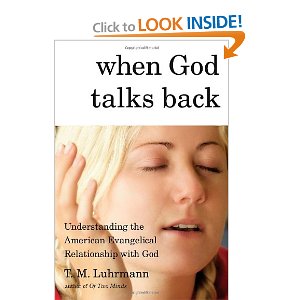
When God Talks Back by  T.M. Luhrmann.
This is a huge volume based on an anthropologist’s report of spending years in two different Vineyard churches throughout the country. I feel like I’m cheating because I actually returned this to the library before I finished it, but I would like to finish it sometime, and I still recommend this to anyone who is intrigued by anthropology or curious about the psychological study of prayer. Which would be… probably no one. I’m okay with being a little nerdy here: I thought it was really interesting. And I truly appreciated that a non-believing author managed to write a book about evangelical prayer without an overwhelming air of cynicism. Though I don’t necessarily agree with some of her conclusions, I appreciated that she took people seriously and wanted to figure out how the human side of prayer works. My biggest beef with what I’ve read so far is that Luhrmann keeps using the word “evangelical,” while most evangelicals probably wouldn’t call the churches she visited mainstream. But, whatever. The evangelical Christian movement is almost impossible to narrowly define, even in a book that’s 300+ pages like this one.
***
Gilead by Marilynne Robinson
Gilead is a beautiful story, told in letters from an elderly minister near death to his seven-year-old miracle son. (While every child is a miracle, one who is seven when his father dies of old age is more likely to be referenced as such, I suppose.) The San Francisco Chronicle said Gilead “explores big ideas while telling a good story,” and I would recommend this for anyone who has thought about God’s will, singleness, marriage, childlessness, parenting, grief, disappointment, ministry, or the meaning of life. Which means, everyone. I liked this so much that I listened to the audio CD a few weeks after reading the book, and I was so excited to share this novel with some friends that I recommended it to several people right away. Then I found out most of them had read it already. So I feel like I was late to the party, but you should read it now, because this is one of those things that isn’t worth missing!

“I don’t know exactly what covetise is, but in my experience it is not so much desiring someone else’s virtue or happiness as rejecting it, taking offense at the beauty of it.” -Gilead, by Marilynne Robinson.

***
Still: Notes on a Mid-Faith Crisis by Lauren F. Winner

I have loved several of Lauren Winner’s other books, especially her conversion memoir “Girl Meets God,” so I was very curious about “Still: Notes on a Mid-Faith Crisis.” Written out of the spiritual torment she faced grieving her mother’s death and doubting her faith in a difficult marriage resulting in an (admittedly) unjustifiable divorce, Winner tells her raw story of doubt and faith. Many times, it seemed that her “journal-entryish” writing (like CS Lewis’ “A Grief Observed,” but a bit more organized) left me feeling emotionally brutalized along with her – doubt is a painful thing, and it hurt to read about, too. In both knowing personally that Christian marriage is not all picnics and rainbows, and walking alongside a dear friend in the aftermath of marital dissolution, I have a hard time feeling sympathy for the trauma Winner faced after leaving her husband. I don’t know the whole story behind that, but I do know she reflected on those grave choices with honesty and renewed faith. It’s not as though she can go back and change it, and I am grateful God meets us where we are instead of where we should be. In many ways, this book reminds us that life is tough and God, though sometimes hard to understand, is good. Winner writes with a haunting narrative voice and her words are thought-provoking in some ways I didn’t expect. For that reason I think it deserves mention here.

“The enthusiasms of my conversion have worn off. For whole stretches since the dream, since the baptism, my belief has faltered, my sense of God’s closeness has grown strained, my efforts at living in accord with what I take to be the call of the gospel have come undone. …And yet in those same moments of strained belief, of not knowing where or if God is, it has also seemed that the Christian story keeps explaining who and where I am, better than any other story I know. … I doubt; I am uncertain; I am restless, prone to wander. And yet glimmers of holy keep interrupting my gaze.” (‘Lord, to whom shall we go? You have the words of eternal life.’ John 6:68, esv.) – Still, by Lauren F. WInner.

I have a few things on my summer reading list already (Eric Metatexas’ Bonhoeffer biography is in progress, Return of the King by Tolkien, the Huger Games trilogy by Suzanne Collins, In This House of Brede by Rumer Godden, and Great Expectations by Dickens), but I’d love to hear more suggestions if you have any to offer!

A Cruel Month

April is the cruelest month, breeding
lilacs out of the dead land, mixing
memory and desire, stirring
dull roots with spring rain…
– TS Eliot, The Wasteland (“Part 1- The Burial of the Dead”)

I’ve never really understood much of the TS Eliot poem “The Wasteland,” to the point where I’m usually not sure the author even had a logical meaning that anyone was supposed to comprehend. This is totally sour grapes on my part, of course. He just means something I have not yet grasped. So I get lost in every attempt, but I keep coming back to these words because some of the imagery and the opening line, “April is the cruelest month,” resonates so clearly with me.

I have had many good Aprils, particularly 1986, when I was born, and the month is not always bad to me. But rain falls on the just and the unjust alike, so I have seen some cruel Aprils. The worst of them were five and six years ago, when Aaron and I were dating. During the first April there was much weeping, wailing and gnashing of teeth, since I was dreading his departure for a deployment to Iraq. (In addition to the cruel April business, Eliot’s poem also says “I will show you fear in a handful of dust,” and confronting the dust-to-dust nature of this all was, indeed, terrifying.) When his pre-deployment training began I didn’t know we would have a brief summer reunion and thought we had kissed goodbye for the year. The day after he left I threw myself into a heap on my bed, surrounded by some girlfriends, and declared “I am being ripped in two!”

"kissing the war good-bye" was above my dorm dresser. also pictured: valentine's flowers.

the "birthday jar" I sent Aaron for his 22nd birthday. I was sick so my mom snapped this while I was in bed.

The second cruel April was a year later, and I was tiredly, anxiously, wearily, fearfully awaiting his imminent return home. It was an awful year in so many ways, and some days it seemed like every breath was a reminder of how fragile we all are. There were funerals, injuries, battles, sickness, nightmares, care packages, letters, emails, and lots of crying (on my part). The experience was more harrowing for Aaron than for me, of course, which appalls me a little to this day.  It has been said that “the darkest hour is just before dawn,” and those words were remarkably true for me that year. Sometime in February, I broke down with a friend while we were leaving the music building. I had been counting down to a rough estimate of Aaron’s homecoming date, and I remember sobbing “There are 73 more days! I can’t do it! This is impossible!” Then it felt like everything was downhill from there, and the last few weeks of deployment were full of insomnia and grotesque nightmares whenever I could get some sleep. I knew after all the difficulty of that year we were not home free yet. Nearly every day I heard people saying “You must be getting so excited!” and I just wanted to scream that he was still in danger and something could still happen to him and there is nothing exciting about someone you love being in a war zone, ever, even if they are scheduled to come home soon.

Then (At last! Finally!), five years ago today, the cruelty of that April came to an end and he was returning home. At that point, I almost wished my insomnia would have stayed a little longer since I was studying, writing, and practicing like crazy at the end of the semester, trying to work ahead as much as possible. Several professors graciously adjusted my scheduled finals so I could celebrate this homecoming – one even handed me an exam, winked, and told me to bring it back before graduation. Grace upon grace.

waiting!

Aside from the homecoming, which I have written about earlier, my favorite memory of this time came a few days later. Aaron was safely home, and the family sat on the couch praying for his upcoming TV interview. His mom asked that God would give him words to speak to the reporter, and his brother interjected, “English words!”

at last!

at last!

It’s interesting to unpack important lessons after trials like this. A few weeks into that summer, I sat with a family friend and watched Aaron perform important ushering duties at his sister’s wedding. (It was on a beach, and I remember him saying, “oh… sand…”) Someone remarked to me that Aaron’s presence here was proof of God’s faithfulness to us, and springing out of the growth and learning of the past year I had to correct them. Yes, God is faithful and gracious, and we received our loved one back from war… but a terrible outcome for that year would not have changed God’s character. I am so thankful that divine faithful character was expressed in this way, but I can’t pretend God “owed” us this safe homecoming. Things could have taken a tragic turn and that April would have been crueler than all the rest, and we could been weeping through a “the Lord gives and the Lord takes away” sort of lesson in it all. But for whatever reason, that was not the case, and we now reflect on this with humility and gratefulness:

 “Who has ever given to God, that God should repay him?” – Romans 11, niv.

“The LORD has dealt bountifully with you. ” – Psalm 116, esv.

Some of these Aprils have been cruel, but I am grateful for what has sprung out from that.
Welcome home, five years ago today.

love is the lesson

Most glorious Lord of life, that on this day,
Didst make thy triumph over death and sin:
And having harrowed hell, didst bring away
Captivity thence captive us to win:
This joyous day, dear Lord, with joy begin,
And grant that we for whom thou didst die
Being with thy dear blood clean washed from sin,
May live for ever in felicity.
And that thy love we weighing worthily,
May likewise love thee for the same again:
And for thy sake that all like dear didst buy,
With love may one another entertain.
So let us love, like as we ought,
Love is the lesson which the Lord us taught.

-edmund spenser.

listening in the wilderness

I feel strange about taking Lent seriously this year because, on the surface, I’m mostly participating on my own. This isn’t something my church (or even my husband) is observing, and so I find myself feeling a little misplaced. I know many people in evangelical circles might argue against Lenten practices like extra church services, fasting and “giving things up.”  And regardless of one’s stance on observing liturgical seasons, every Christian would agree that faith is an internal work of God, not external, not of ourselves. I believe there is much value in traditional celebrations like this, because corporate expressions of faith that spring out from the genuine belief of individuals are a strong witness of our Christian unity and devotion. And though the people I spend my day-to-day life with aren’t really walking on this road with me, I’ve found encouragement that I am actually not alone. Since this Lent thing is something many Christians all over the world are doing right now, too, by setting aside a few weeks as a significant season of prayer and repentance in my own life, I’ve found common ground with friends and family who worship in a variety of traditions and styles very different from my own.

One of my dear Lent-observing friends, Bethany, is a treasure all her own. We met when I was leading her freshman bible study in college and really hit it off over some cookie-baking in my apartment. I always felt those bible study girls taught me more than I ever hoped to teach them, and my friendship with Bethany consistently reminds me of this unexpected blessing. I continue appreciating her beautiful articulations of faith and life, especially recently while reading the same copy of the Bible I used when we studied together, rediscovering profound “Bethany Kj” commentary scribbled in the margins.

While she blogs occasionally about teaching, literature, food, church, and having a cool apartment, Bethany agreed to share some “serious” reflections about Lent here. Her thoughts on this topic began at a young age with the traditional soup dinners and extra services at her Missouri-Synod Lutheran church, and today she finds Lent observance as an encouragement in the midst of weariness and brokenness. In reading this, I found myself thinking of the seventh chapter in Romans where Paul talks about wrestling with the “body of death,” which is what we do during Lent, and praises God that the solution is in Jesus and the resurrection.

“Thoughts on Lent,” from Bethany Kjergaard.
My earliest memories of Lent are sense memories. I remember the smell of the soup for the communal supper before the service (I didn’t eat soup, too picky). I remember the early darkness. We would arrive to church at twilight, and we would leave just before my bedtime. I remember snatches of the liturgy we sang (“let my prayers rise up like incense before you”). The hymns we sang during these Wednesday night services were much more melancholy than the ones we sang on Sunday morning. The services were much shorter too.

As I grew older, Lent became one of my favorite seasons of the church year. Last year I don’t think I missed a Lenten service (and I really don’t like going to church all that much). I think I treasure Lent because normally I feel that I’m supposed to pull it together for church each week. We are exhorted to be joyful in the Lord. Most Sundays I’m surrounded by happy, smiling people. Not so during Lent. During this season I can take the time to be grief-stricken at my sin and my hard heart. I don’t have to “fake it until I make it.” Rather, I can look around me and see that I am broken and the world is broken. As a Christian, one of the most difficult things is looking at the world around me and realizing that while Christ came and was resurrected and lives, it often does not seem that he has made much of a difference. We still have wars, poverty, and famine. The universal church does a lot of good things and a lot of bad things. Time marches onward.

I’ve been reading different meditations on Lent and what this season ought to mean to us. One of the most powerful comes from St. Benedict, and it is the idea of the New Adam and the Old Adam. Old Adam fell and was cast out of paradise into the wilderness. Humanity wandered in this “wilderness” until the New Adam (Christ) journeyed out into the wilderness to bring him back. Lent is recognition that although our path has been made known to us, we are still in the wilderness, the darkness of this world.

I think the darkness of the church during these services made the biggest impact on me. It was very dim with only the altar candles lit. Bernard Clairvaux commented that sin entered the world through sight (Eve being tempted by the beauty of the fruit), but salvation comes through the hearing of the Word. Darkness certainly obscures sight, but it cannot stifle sound. Lent is a time that allows me to admit that I am fallen, in the wilderness, in the darkness and yet despite that I can listen.

giving up

A little over a week into Lent, I’m surprised at how scattered my thoughts about self-denial and repentance remain. I suppose it’s not a very fun thing to think about. At least with the other “big” Church season of Advent, we prepare for the revelation of Word made flesh while planning holiday menus and anticipating the spiritual experience of getting loads of loot. Not so with Lent! For nearly two thousand years, Christians have spent forty days in repentance and self-denial preparing to observe the most extreme series of events in human history: Jesus’ undeserved betrayal and gruesome death that make way for the eternal victory of His resurrection.

It can be rightly said that this is a special season of grief for sin and brokenness in ourselves and the world, and turning away from these things back to God. Of course we should seek repentance at all times, but that doesn’t make Lent irrelevant. There is much to gain in approaching this corporately and systematically — or, to use the evangelical lingo, “in community” and “intentionally.”  Compared to our full observance of Christmas (and sometimes Advent), we evangelicals tend to tend to sweep Lent and Easter under the rug. Perhaps this is further evidence of our own brokenness, indicating that we don’t always take the the death and resurrection of Christ as seriously as his birth.

My thoughts and convictions on this topic are still not fully formed, but mostly my point here is that these forty days are a special time of examining my own heart and orienting myself more fully towards the gospel. In giving up small things – this year, it’s sleeping in past six o’clock and using the computer after dinner – I’m more aware of how much I hang on to and how much Christ gave up for me. And I’ve failed at one or both of these things every day. This teaches me even more about my own rebellion and powerlessness, and how much I must cling to God in all things. I want Lent to be a big deal because these tangible experiences help break me out of my own fallen perspective and emotions. Rightly understanding my own state of helplessness and defeat is the only way I can rightly understand what the gospel means. In Lent, when I turn my heart towards sorrow for sin and grief for all that brokenness has wrought in my life and the world, I gain a deeper understanding of St. Paul writing: “For as in Adam all die, even so in Christ shall all be made alive!” and the traditional liturgy stating: “Thus we proclaim the mystery of faith – Christ has died, Christ has risen, Christ is coming again!”

Though “giving up something for Lent” alone is meaningless, with a contrite heart the tradition of fasting and denial teaches us about surrender, sacrifice, and salvation. These lessons are profoundly valuable. I’m glad to be observing Lent this year, because I know in “giving up”  little things  to make room for greater devotion to God, I’m learning more about giving up entirely.

“…whoever loses his life for my sake will find it.” – Matthew 10:39, esv.

Thou art the journey

I love this prayer from Boethius, a 6th century Christian:

O Father, give the spirit power to climb
To the fountain of all light, and be purified.
Break through the mists of earth, the weight of the clod,
Shine forth in splendor, Thou that art fair weather,
And quiet resting place for faithful souls.
To see Thee is the end and the beginning,
Thou carriest us, and Thou dost go before,
Thou art the journey, and the journey’s end.

-Boethius, c. 480-524 AD.

(photo found here)

“fear not”

Whether you focus on the spiritual themes of Advent or jump ahead into Christmas celebrations, the weeks leading up to the holidays are full of waiting and excitement. While anticipating Christmas brings joyful hope, patience for other things in life is often very raw, destabilizing and scary. Especially when life is wearisome, the holiday waiting can hit a nerve of underlying or unrecognized fear.  It’s easy to picture happy children marking passed days on the calendar expecting another magical December 25th, but the rest of life isn’t like that. We don’t know what, when, or even if things will happen, and the things that do end up happening might be hard or painful. Depending on the person and their circumstances these contingencies may be especially terrifying, but it’s safe to say we all face this battle in some way. At this time of the year it might feel like the chasm between happy hope and our own gaping wounds is uncrossable. Uncertainty can make celebrations feel so painful for some, and these challenges seem worse with messages all around urging happiness and merriment.

There’s no use hiding these hard feelings, and I’ve been thinking about this because this theme of nagging anxiety has been a theme in so many conversations I’ve had lately. There are varied stories, of course, but most of us respond to all sorts of pain by asking similar questions:
What if I don’t succeed in this new endeavor – grad school, starting a business or job, parenting, paying off debt, leadership responsibilities, moving?

     What if the person I love rejects me and I’ve poured myself out for nothing?
     What if it takes forever to recover after this awful thing?
     What if things don’t get better?
The letters I-F in “what if?” give us a quick way to reveal what I Fear, and I confess a sinking familiarity with this list because I’m asking the same questions on some level every single day. I don’t think these fears are unique to anyone!

It shouldn’t be that surprising to confront growing fear while preparing for Christ’s coming. The Israelites must have mused, Our prophets seemed like they were crazy anyway, we were captured and in exile, and now we’ve had hundreds of years without a messenger from God… What if this is all a joke? Shouldn’t the Messiah be here by now? An angel had to command Joseph not to fear taking Mary as his wife. The shepherds were terrified for one of the most glorious fresh-air Angelic choir concerts of all time. And even today we’re bombarded with skepticism about Jesus’ return: Look at people like Howard Camping! Is it crazy to think this is real? Shouldn’t Jesus be back by now?  Human fear permeates the story of Christmas, so why shouldn’t contemplating the mysteries of Christ’s coming bring our own everyday fears to light as well?

The Christmas story is beautiful here as it validates and releases these fears with  the messages of our Advent contemplations – hope, peace, joy and love.
Weary Israel: This is the branch from Jesse, with the spirit of the fear of the Lord, which remedies all the rest of your fears.
Take courage, Joseph: These crazy and embarrassing circumstances you don’t understand fulfill my promise to bring forth salvation.
Good news, lowly Shepherds:  Salvation comes for all people, including you.
Be not afraid: God is incarnate, dwelling among us that we may behold him.

Reinforcing the truth of scripture, many Christmas carols proclaim the Christ child is the antidote to fear.
Yet in thy dark street shineth the everlasting light!
The hopes and fears of all the years are met in Thee tonight.
– “O Little Town of Bethlehem” words by Philip Brooks, 1867.

Saints before the altar bending, watching long in hope and fear,  
Suddenly the Lord descending in His temple shall appear!
– “Angels from the Realms of Glory” words by James Montgomery, 1816.

Come, thou long-expected Jesus, born to set thy people free
From our sins and fears release us, let us find our rest in thee!
– “Come Thou Long Expected Jesus” words by Charles Wesley.

(Advent Starry Night by Virginia Wieringa)

And it’s interesting to note what happened after these Christmas story fears were confronted. Joseph woke up from his dream and obeyed the angel’s command.  The shepherds went from their fields to find the stable in obedience to their instructions. They responded to fear by acting on what God had revealed to them, and that’s the same path we can take to push past fear. In yielding any worry, big or small, we encounter the ultimate revelation God has given us – Christ, the Word made flesh.

Be not afraid; say unto the cities of Judah, Behold your God!”   – Isaiah 40, king james version.

[image here]